Sofia’s Journey · Part 5 of 9 · Muscat
Muscat. The Country That Doesn't Move.
UTC+4. Year-round. The most honest timezone on the route.
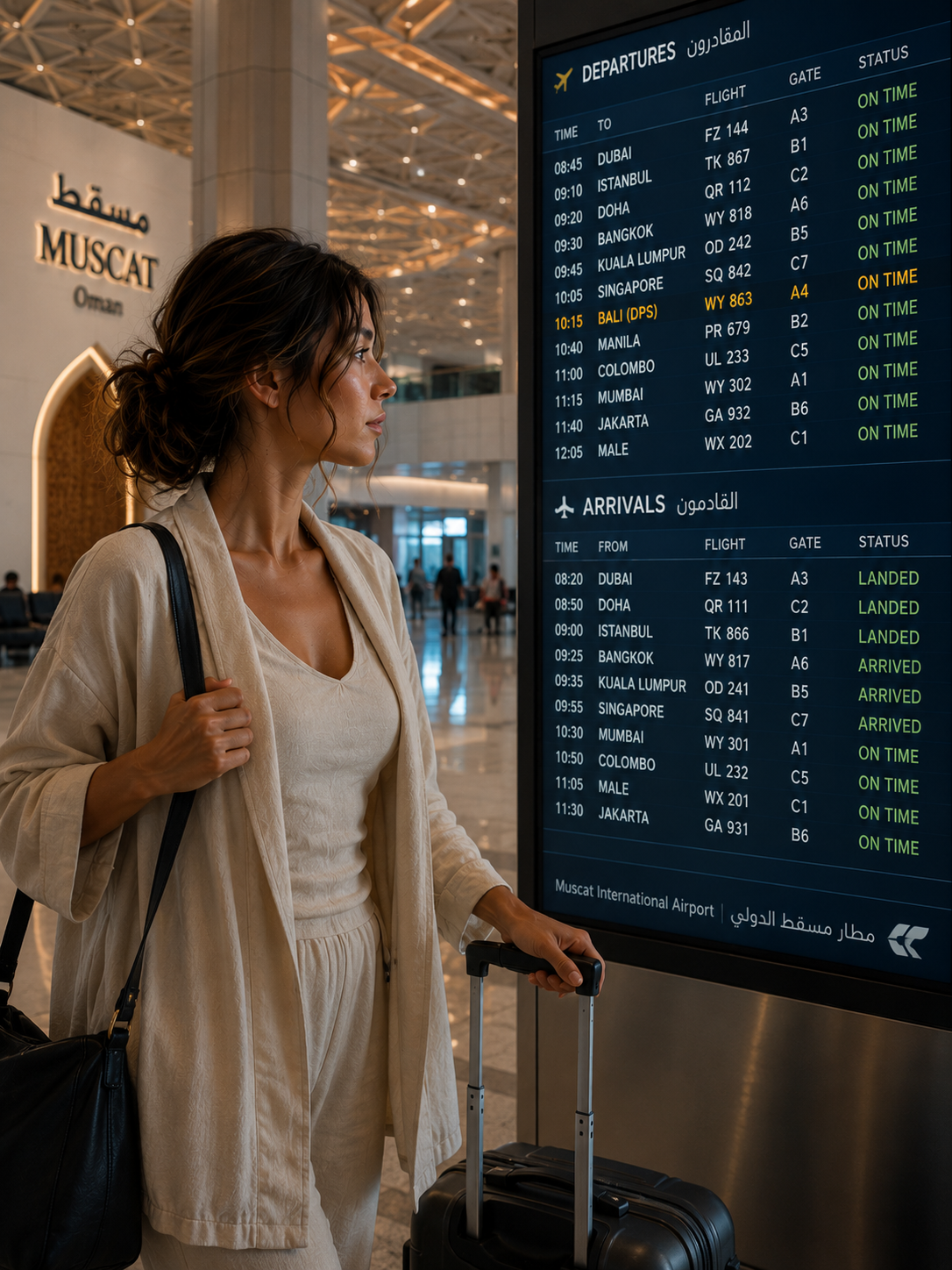
Muscat International at 02:40 is a specific kind of nowhere.
Not unpleasant. Clean, actually — the terminal has a quality of maintenance that suggests genuine care rather than the performance of it. The marble floors. The particular smell of Gulf airports, which is its own category: cool air, a trace of oud, the neutral industrial underneath. The lighting at this hour is full brightness because airports do not have hours in the way that cities do. They are always open. They are always lit. They exist outside the agreements that the rest of the world makes about when darkness is appropriate.
Sofia's body is at approximately 23:40 Miami time. Day 4.
She has adapted three hours since landing in Nice. Three hours gained, three remaining. The biological morning that fired at 13:00 local in Monaco two days ago fired at 15:30 local on the flight. Tomorrow in Bali — if her calculation is correct, and Zkomi has confirmed it is — it will fire close to local morning for the first time. Not perfectly. Close.
She is moving in the right direction. Slowly. Which is the only speed available.
The layover is four hours and twenty minutes.
She finds a seat near a window. Outside the terminal the tarmac is very bright under the floodlights and beyond it the darkness is complete — the Gulf of Oman somewhere out there, the Hajar Mountains behind the city, Muscat itself asleep in the hills. She has never spent more than a layover in Oman. She has always meant to come properly. There is a quality to the Gulf states at night from airport windows that makes her think this every time — a sense of density behind the darkness, of a place with more interior than the brief passage through it reveals.
Oman does not observe daylight saving time.
It never has.
This is not an oversight. Most of the Gulf states made the same decision — Saudi Arabia, UAE, Qatar, Kuwait. The reasoning varies by country. In Oman's case the stability is almost philosophical in its consistency. The clocks have not moved in living memory. UTC+4, year-round, without adjustment, without the biannual disruption that Europe and North America impose on their populations and that Sofia has always found faintly absurd — the idea that the entire biological architecture of a population should shift by an hour twice a year because of a decision made in 1916 to conserve coal.
For a traveler with a protocol, Oman is one of the most honest timezones on earth. What it says is what it means. UTC+4 now. UTC+4 in December. The sun rises at approximately the same time relative to the clock throughout the year, within the natural variation of the seasons. There is no false spring morning in October, no artificially extended evening in summer.
She finds this restful to think about. Not useful, exactly. Restful.
The cold chain is what needs attention.
The kitchen cold store in Monaco performed correctly. The Muscat transit is the problem — four hours in a terminal with no hotel, no kitchen facility, no refrigeration she controls. The compounds have been in the carry-on since she left the Monaco hotel three hours ago. Cabin temperature on the flight: approximately 21 degrees. Ambient in the terminal: approximately 19 degrees.
She opens the app.
Cold chain: 3h 20m at ambient. BPC-157 and Ipamorelin: within window. TB-500: within window. Next refrigeration required before hour 24 of current exposure. Estimated arrival Bali: 09:40 local. Total exposure at arrival: approximately 18 hours. Within window for all compounds.
She closes it.
This is the triage. Eighteen hours at ambient by the time she reaches the hotel in Bali. BPC-157 and Ipamorelin are stable up to approximately forty-eight hours at this temperature. TB-500 somewhat longer. She has margin. Not unlimited margin — margin.
There is a pharmacy in the terminal, she knows from a previous connection, that sells small ice packs. She considers this. Decides against it — ice packs in a carry-on introduce moisture risk, and the compounds are in sealed vials. The ambient is stable enough. She will manage with what she has.
This is the continuous triage of traveling with a protocol. Not crisis management. Margin management.
She is buying water at a kiosk when she sees him.
Daniel. Gate 14. His carry-on beside him, the same stillness, a different jacket. He is looking at his phone with the particular expression of someone reading something they did not want to read.
She takes her water. Sits two seats away from him.
He looks up.
He says: Bali.
She says: Bali.
He says: same flight.
She says: apparently.
He goes back to his phone. She opens a book she has been carrying since Miami and has read eleven pages of. The terminal is quiet around them. Somewhere deeper in the building a cleaning machine moves along a corridor, its sound arriving and then fading. An announcement in Arabic and English, something about a gate change, neither of them moving.
After a while he says: how is your cold chain.
She says: managed. Yours.
He says: I was in a hotel in Monaco with a minibar problem. Someone helped me sort it.
She says: I know.
He says: the kitchen cold store held at three degrees all night.
She says: it usually does. You just have to know to ask.
He says: you said that already.
She says: it was worth saying twice.
A pause. Outside the floodlit tarmac. The deep darkness beyond it.
He says: how long have you been doing this. The whole thing. The protocol across timezones.
She considers the question. Not performing consideration — actually thinking about when it started. The first trip where she noticed the flatness. The research that followed. The gradual construction of a system. Several years, now. Long enough that it is not a discipline anymore. Just how she travels.
She says: long enough that I don't think about it much.
He says: that's the goal, isn't it.
She says: that's always the goal.
The cleaning machine returns down a different corridor. Further away this time.
He says: I've been dosing at local time. The whole route.
She says nothing. Waits.
He says: Monaco was fine. But yesterday on the flight I felt — off. Not tired. Something else.
She says: your cortisol peak is still in Singapore. Your compounds are landing four to five hours before the window opens. It's not the compounds. It's the timing.
He looks at her.
She says: what are you running.
He tells her. She listens. BPC-157 and TB-500 and one other compound she knows well. A protocol that is correctly designed and incorrectly timed, which is a specific kind of frustration — like a well-written score played in the wrong key.
She says: your biological morning right now is approximately 18:30 Muscat time. You missed it today by five hours. Tomorrow in Bali it will be around 19:30 local. The day after, 20:30. You're adapting westbound from Singapore, which is the easier direction. By day four in Bali you'll be close to local morning.
He is quiet for a moment.
He says: how do you calculate that without looking anything up.
She says: practice. And the app does it.
He says: Zkomi.
She says: Zkomi.
He looks at his phone. Then at the gate. Then at her.
He says: four hours is a long layover.
She says: Oman doesn't change its clocks. UTC+4 year-round. Most stable timezone in the region.
He says: is that relevant right now.
She says: I find it relevant. The idea that some places just — stay where they are.
He considers this.
He says: some people do that too.
She says: yes.
Outside, the first plane of the morning taxis slowly across the tarmac toward a distant runway. Its navigation lights steady red and green in the dark. The sound of it arriving later than the sight, low and distant through the glass.
Four hours is a long layover.
They talk.
Zkomi is evolving carefully. We’ll let you know when the mobile apps land.
Sofia’s Journey is a serialised editorial story about travel, biology, and the invisible systems that hold a protocol together across borders. The science is accurate. The timezones are correct. The rest is Sofia.