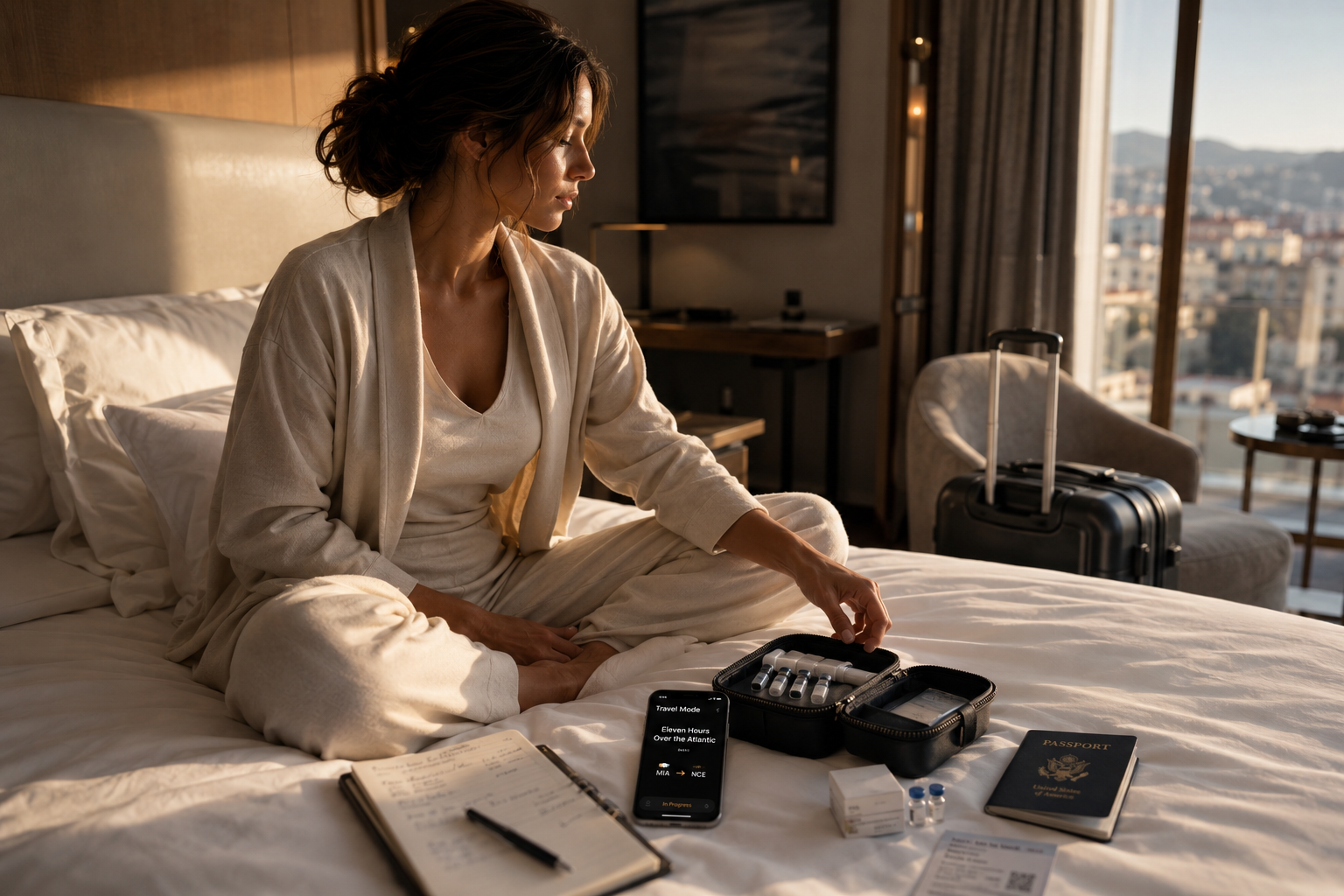
Sofia’s Journey · Part 4 of 9 · Monaco
Monaco. Three Kilometres.
The same timezone. A different country. The fridge conversation.
The drive from Nice to Monaco takes twenty minutes on a good morning.
The road follows the coast — the Basse Corniche, the lowest of the three roads that run east along this section of the Riviera. To the left the sea. To the right the cliff face, occasionally interrupted by a tunnel, and then the cliff again. The light at 09:00 on Day 2 is different from the light at 06:31 on Day 1. Warmer. More committed. The sea has turned from grey-blue to something closer to what people mean when they say Mediterranean.
Sofia takes a taxi. She watches the water and does not think about anything in particular.
Her body is at 03:00 Miami time.
Yesterday she managed Day 1 correctly — light exposure on the terrace, no sleep before evening, the midday dose timed to biological morning. She slept at 22:00 local, which was 16:00 Miami, which was too early by Miami standards but necessary by destination logic. She woke at 06:30. Her body woke her at what it calculated as approximately 00:30 Miami — not the cortisol peak, not the clean morning signal she has at home, but something. A beginning.
The protocol is intact. Slightly compressed. Not broken.
One hour gained. Five remaining.
Monaco is not a city.
It is a city-state — the second smallest sovereign nation on earth, 2.02 square kilometres of coastline, cliff, and reclaimed land pressed between France and the sea. It has its own government, its own police, its own tax code. It does not have its own timezone. It shares France's — Central European Summer Time, UTC+2 in May — which means Sofia's body clock problem does not change at the border. The displacement continues.
What changes is the regulatory environment.
France has one framework for what she carries. Monaco has another. The same compounds in the same case cross a border that is invisible from the road — a slight widening of the pavement, a flag, a change in the texture of the architecture — and exist under different rules.
She has the documentation. She carries it in the same sleeve as her passport. This is habit, not anxiety.
The taxi passes through without stopping. The driver does not mention the border. Why would he. He has driven this road several thousand times.
The hotel is in the Carré d'Or. A small lobby. Very quiet. The kind of quiet that is maintained rather than natural — the specific acoustic signature of money, which absorbs sound the way certain materials absorb light.
She is checking in when she sees him at the concierge desk.
The man from the plane. From the immigration queue. From the terrace in Nice.
He is asking something in French. His French is functional rather than fluent — she catches this from across the lobby in the way that people who speak multiple languages catch it in others, not as judgment but as information. He is asking about refrigeration. Specifically, whether the minibar in his room can be adjusted below the standard hotel setting of eight degrees.
The concierge is explaining, with practiced patience, that the minibar is a fixed unit.
Sofia finishes her check-in. Takes her key. Crosses the lobby.
She says, in French, to the concierge: the kitchen will hold items at two to four degrees if the guest provides a medical reason. They do this routinely. It is not advertised.
The concierge confirms this, with slightly less practiced patience, as if the information is correct but the manner of its delivery is not what he expected.
The man looks at her.
She looks at him.
He says, in English: how do you know that.
She says: I've stayed here before.
He says: that's not what I mean.
A pause. The lobby quiet around them.
She says: what you're carrying needs two to four degrees, not eight. The minibar won't hold it correctly overnight. Ask them to log it as a medical item. They'll put it in the kitchen cold store. You collect it in the morning.
He is quiet for a moment in the way that people are quiet when they are recalibrating.
He says: how long have you been traveling with a protocol.
She says: long enough.
She takes her key to the elevator.
Her room faces the port. The yachts are already moving — the specific choreography of a Monaco morning, the harbour traffic, the tender boats, the particular geometry of extreme wealth in a very small space. She has never found Monaco beautiful in the way Nice is beautiful. It is impressive. Impressive and beautiful are not the same thing.
The minibar: eight degrees. She calls the front desk, gives the medical reason, arranges the transfer to the kitchen cold store. The case goes down with the porter. She watches it go with the specific quality of attention she gives to things she cannot control once they leave her hands.
Sixteen hours at ambient during the flight. Three hours at incorrect refrigeration before she noticed yesterday in Nice. Now correct. The compounds are within window. She has not lost anything.
This is what traveling with a protocol actually requires — not perfect conditions, which do not exist, but continuous triage. The ability to assess, adjust, and continue without drama.
She takes the morning dose on the balcony at 13:00.
Day 2 adjustment: biological morning is now approximately 13:00 local, having shifted one hour forward from yesterday's 12:00. The cortisol peak is moving. Slowly. In the right direction. She feels it differently today — slightly sharper than yesterday, slightly closer to the clean morning signal she knows from home. The body reporting its own progress.
The sea is doing what the sea does.
Her phone shows a message from the conference organiser — the reason she is in Monaco, a two-day event on longevity protocols, the kind of gathering that happens in places like this because the people who attend them can afford to be in places like this. She replies. Confirms her session time. Puts the phone face down.
In the evening there is a reception on a terrace above the port.
The man is there. Of course he is. She has started to understand that they are moving through the same circuit — the same events, the same hotels, the same narrow geography of a particular professional world. This is not coincidence. It is topology. There are only so many places where these conversations happen.
His name is Daniel. She learns this from a name badge, not an introduction. He is based between Singapore and Tokyo. Something in longevity medicine or the financing of it — she does not ask precisely and he does not offer precisely, which she finds appropriate. People in this world tend to be specific about what they do and vague about how, or vice versa.
They stand at the railing above the port.
He says: the kitchen cold store worked.
She says: it always does. You just have to know to ask.
He says: is that what Zkomi is for.
She looks at him.
He says: I saw the app when you were at the terrace in Nice. Yesterday at midday.
She considers this. Not the fact of being observed — she does not mind being observed — but the fact that he noticed the specific app, which requires a specific level of attention to a specific kind of detail.
She says: partly. It also tells me when to dose. Which is more complicated than it sounds when you've crossed six timezones.
He says: I know.
Below them the harbour lights are coming on. The yachts shifting slightly on their moorings. Monaco compressing into its evening configuration — smaller than it already is, somehow, the streets quieter, the energy contracting toward the casino and the hotel bars and the private dinners on terraces exactly like this one.
She says: where are you going after this.
He says: Muscat. Then probably Singapore.
She says: I'm going through Muscat.
He says nothing. She says nothing. The harbour lights continue coming on.
This is how these things begin, in this world. Not with intention. With itinerary.
Zkomi is evolving carefully. We’ll let you know when the mobile apps land.
Sofia’s Journey is a serialised editorial story about travel, biology, and the invisible systems that hold a protocol together across borders. The science is accurate. The timezones are correct. The rest is Sofia.