Sofia’s Journey · Part 8 of 9 · Miami
Miami. What Remains.
Westbound is always easier. The body leads the clock home.
The westbound crossing is different in every way.
The same ocean. The same altitude. The same particular darkness of a long-haul night flight over water. But the direction reverses everything that matters biologically — the body now moving with the clock rather than against it, drifting in the direction it has always preferred, the free-running period of 24.2 hours working for her rather than demanding to be overcome.
She sleeps eight hours over the Pacific and the American continent.
Not the managed biological delay of the Nice flight. Not the careful assessment of whether the sleep architecture was correct. Just sleep. The body doing what bodies do when they are finally pointed in the right direction and given enough darkness and enough time.
She wakes somewhere over the Gulf of Mexico.
Her cortisol is rising. Miami time. The correct Miami time — not displaced, not approximated, not calculated from an anchor held six timezones back. The real thing. Home.
Suvarnabhumi to Miami is sixteen hours with a brief technical stop.
She has used the time. Not productively in the way that would have seemed correct to an earlier version of herself — not working, not optimising, not filling the hours with the performance of usefulness. Reading, partly. Sleeping, substantially. Thinking, in the unfocused way that long flights permit when you stop trying to direct the thinking.
She has thought about Daniel.
Not obsessively. Not with the quality of attention that would concern her if she noticed it. More in the way that a new fact situates itself in existing knowledge — the way you keep returning to a calculation not because it is wrong but because you are still finding its implications.
They move in the same circuits. They carry similar cases. They have stood at the same windows in Nice and Muscat and Bali and looked at the same water from different angles. They have talked about refrigeration and cortisol and timezones with the directness of people who no longer need to perform unfamiliarity with the topics as a form of social safety.
She has not answered his last message. Not because she does not know what to say. Because she knows exactly what to say and she has not decided yet whether she is ready to say it.
This is, she recognises, its own kind of timezone problem.
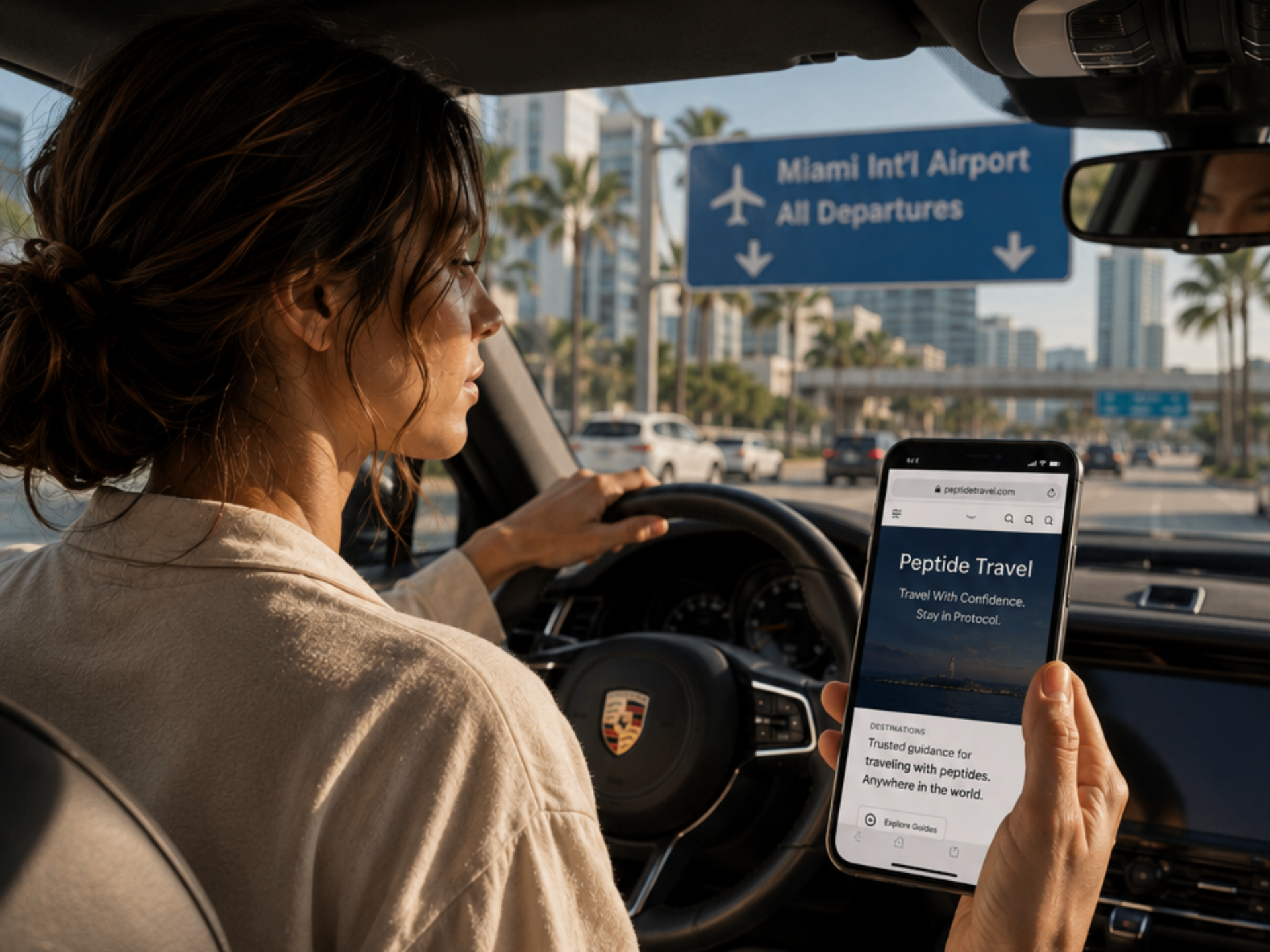
Miami International at 08:47 local.
She knows this airport the way she knows her own apartment — the specific geography of the terminal, the light, the particular quality of South Florida air that meets you at the exit doors even before you reach them, warm and slightly salt-tinged even at this distance from the water.
Customs is routine.
She has the document sleeve. The Zkomi travel document for all three compounds — the formatted record of what she carried, at what doses, on what schedule, across which borders. The Peptides Passport verification for each supplier, QR codes linking to the independent third-party records: batch testing, purity certificates, chain of custody.
The officer looks at the compounds listed. Looks at her.
He says: what are these for.
She says: recovery and anti-inflammatory protocol. The documentation includes supplier verification and batch testing records.
He looks at the QR code on the Peptides Passport document. Scans it with his phone. Reads whatever he reads.
He says: these are research peptides.
She says: yes.
He says: not controlled substances.
She says: no. The documentation confirms that.
He stamps the passport. Returns the documents. Moves to the next traveler.
Forty-five seconds. The entire interaction. The preparation that made it forty-five seconds rather than forty-five minutes began in Monaco, when she understood that documentation is not bureaucracy. It is the translation of what you know into a language that a stranger, in a brief and pressured interaction, can quickly understand.
The apartment.
The east-facing windows. The light she left thirteen days ago coming through at the same angle it always comes through, reliable as the cortisol that rises with it.
She puts the case in the refrigerator. Closes the door. Stands in the kitchen for a moment in the specific stillness of return — the room exactly as she left it, the air slightly stale in the way of closed apartments, the small evidence of departure still present: the coffee cup rinsed but not put away, the charger on the counter, the minor archaeology of a life interrupted mid-motion.
She opens a window.
The Miami morning comes in. The boat somewhere on the water. The light immediate and committed and warm.
Her phone shows the Zkomi screen.
Protocol status: synced. Day 13. Welcome home.
She does not close the app immediately. She reads the journey summary it has generated — the departure anchor, the adaptation curve, each timezone, each dose window, each cold chain event. The record of everything that held and everything that needed managing and everything that arrived intact.
Thirteen days. Seven timezones. Three compounds. One protocol.
Intact.
She makes coffee.
Stands at the kitchen window with it in the way she stood there thirteen days ago, before the departure, before the packing, before the flight. The same window. The same light. The same coffee. The same body — rested, recalibrated, carrying everything it left with and nothing extra.
She picks up her phone.
Opens Daniel's message. The one from Tokyo. The one she has read six times without answering.
I think that's true of more than protocols.
She types.
She does not summarise what she types. It is the kind of message that takes time to write and is not improved by witnesses.
She sends it.
Puts the phone down.
Drinks the coffee.
The Miami morning continues doing what Miami mornings do — insistent, warm, already certain of itself. The cortisol peak is arriving correctly. The system is open. The window is the same window it always was.
Some things you cannot make arrive faster.
Some things arrive anyway.
Zkomi is evolving carefully. We’ll let you know when the mobile apps land.
Sofia’s Journey is a serialised editorial story about travel, biology, and the invisible systems that hold a protocol together across borders. The science is accurate. The timezones are correct. The rest is Sofia.